Jennifer Murray – Founder & CEO, JMC
May 2026
What you need to know before the law forces the issue. By Jennifer Murray, Founder of JMC HR Consulting
Executive Summary
- Bill 24, the Pay Transparency Act, was introduced on March 18, 2026. It will require salary ranges in job postings, ban salary history questions, protect employees who discuss wages, and mandate annual pay transparency reports for employers with 50 or more employees.
- Royal Assent is likely in late spring or early summer 2026, with a compliance window probably landing in late 2026 or early 2027. Building defensible ranges and auditing internal equity takes longer than that window allows.
- Unlike Ontario, NB’s bill currently includes no cap on range width. Wide ranges meant to game the spirit of the law will erode credibility with candidates and employees.
- The talent math is unforgiving. The stats tell us…60% of job seekers won’t apply to a posting without a salary range. 68% would switch employers for greater pay transparency at the same pay. Pay transparency lifts retention by 30% or more.
- New Brunswick’s context sharpens the stakes. 51% of NB owners cite labour shortage as their number one issue, and Atlantic Canada’s immigration tailwind is reversing. Posting “competitive compensation” is now ‘not acceptable’…and a self-inflicted wound on the candidate funnel.
- The most common employer mistake in other provinces is posting public ranges before auditing internal pay equity. Compression that was invisible becomes the first thing employees notice. Audit first, then post.
On March 18, 2026, the New Brunswick government introduced Bill 24, the Pay Transparency Act. It still has to clear second reading, committee, third reading, and Royal Assent. With a Liberal majority and strong public support, that timeline runs to early summer 2026, with a compliance window likely landing in late 2026 or early 2027.
The strategic question isn’t whether transparency is coming. It’s whether your organization leads the moment or gets dragged through it.
For executive teams, the conversation is no longer about whether to post ranges. It’s about what those ranges say about how the organization values its people, how disciplined its compensation structure actually is, and how prepared leadership is for the questions that follow.
Bill 24 doesn’t just change job ads. It changes what your compensation practices are willing to defend in public.
What the Bill Requires
Bill 24 was tabled by Hon. Lyne Chantal Boudreau, Minister of Seniors and Minister responsible for Women and Gender Equity. Four obligations matter.
Salary ranges in every job posting
The rule covers both internal and external postings. Unlike Ontario, which caps ranges at a $50,000 spread for roles under $200K, New Brunswick’s bill currently includes no cap. Wide ranges designed to dodge the spirit of the law won’t hold up in candidate decisions or boardroom conversations.
No more salary history questions
The province joins BC, PEI, and Ontario in retiring a question that mainly served to carry forward existing pay gaps. The mechanism is straightforward. If a woman, a racialized worker, or anyone underpaid in a previous role gets asked what they made before, the next offer almost always anchors to that number plus a polite increment. Past inequity compounds forward, one offer at a time.
Banning the question doesn’t fix the underlying gap, but it’s designed to stop employers in the chain from quietly reinforcing it.
The legal nuance worth knowing is that Bill 24 prohibits the employer from asking.
It does not prevent a candidate from volunteering the information, and it does not prohibit a conversation about salary expectations. Those are different questions with different mechanics. “What were you paid?” is a backwards-looking anchor. “What are you looking for?” is a forward-looking negotiation. The first quietly imports old pay gaps. The second invites the candidate to set their own number, which they will calibrate against your posted range.
The practical change is simple. Strip the question out of your application forms, your applicant tracking system templates, and your hiring manager interview guides. Replace it with a salary range up front and a single line asking whether that range works for the candidate’s expectations. The screening that the salary history question pretended to do is done better, faster, and more fairly by transparency itself.
Hiring managers are usually the slowest to drop the question, partly out of habit and partly because they believe it gives them leverage. It doesn’t, and it hasn’t for years. Candidates with options will refuse to answer or deliberately overstate. Candidates without options are exactly the people the question was extracting value from, which is the reason it is being retired in the first place.
There is also a reputational dimension worth taking seriously. Once Bill 24 takes effect, a single recorded interview question can become a Glassdoor review, a LinkedIn post, or a human rights complaint. The cost of one untrained interviewer asking the old question is significantly higher than the cost of training every interviewer not to.
Protection for employees who discuss wages
Employees are already comparing notes. The law just confirms they can do it openly. What changes is the legal posture around those conversations, not their existence.
Most NB employers have confidentiality language somewhere in their offer letters or HR policies that prohibits or discourages employees from discussing compensation. Some of that language was already unenforceable under Canadian labour law. After Bill 24, even the chilling effect becomes a liability. An employer who fires, demotes, reduces hours, or quietly sidelines an employee for discussing pay is exposed not just to a wrongful dismissal claim but to a statutory reprisal complaint. The penalty math gets worse, not better.
For executives, the more important shift is cultural.
Pay conversations between employees used to be treated as a problem to contain. Under the new framework, those conversations are the diagnostic. If two employees with the same role and similar tenure compare notes and the numbers raise questions you can’t answer, the problem isn’t the conversation. The problem is the compensation decision behind it. Discouraging the conversation only delays the moment the question gets asked publicly, and the public version is always more expensive.
Generational expectations make this almost moot anyway. Workers under 35 share pay information freely as a default. They post salaries on LinkedIn, compare offers in group chats, and treat the question as routine. The employees most likely to test your pay practices are often the ones you most want to retain.
The practical move for leadership is to update three things.
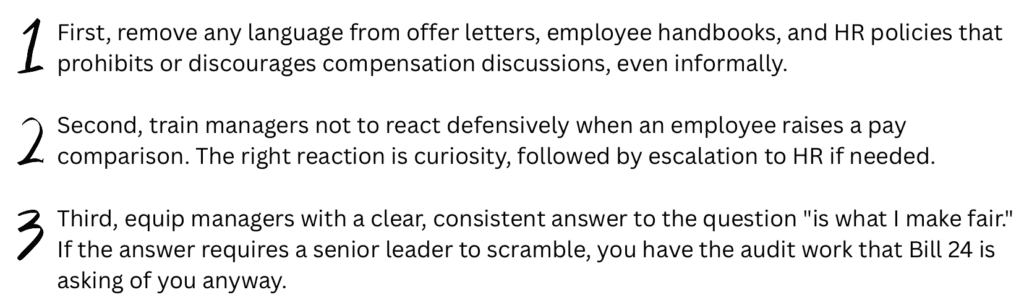
There is also a quieter benefit worth naming. Organizations that take a posture of “we welcome the conversation” alongside transparent ranges tend to surface compensation issues earlier, when they are still cheap to fix. Organizations that signal “we’d prefer you didn’t” surface the same issues later, in exit interviews or social media posts, when fixing them costs far more.
Annual pay transparency reports for employers with 50 or more employees
This is the most consequential provision. Reports must be submitted and publicly posted. Compensation data becomes visible to competitors, investors, customers, candidates, and the press. If you employ more than 50 people, this is the provision that should be driving your prep work.
Why This Matters Beyond Compliance
Pay transparency reshapes the talent market. Pay secrecy stopped working before the legislation arrived. Water cooler, Glassdoor, LinkedIn, Reddit threads, and informal employee comparisons already give workers and candidates most of what they need.
Bill 24 is not introducing transparency into a system that didn’t have it. It is closing the gap between what employees can already find out and what employers are willing to confirm. That gap is where mistrust grows.
The candidate funnel without a salary range is no longer competitive. 60% of job seekers say they won’t apply to a posting without one. 65% of LinkedIn postings now include employer-provided ranges, up from 45% a year earlier (LinkedIn, 2026). Silence used to be neutral. It now reads as below market.
It was reported that a 22% increase in employee trust and roughly 20% lower turnover exists in a transparent pay environment. The most striking number, from Visier, is that 68% of employees would switch employers for greater pay transparency at the same pay. Same dollar. Different employer. Just for being clear.
Gallup data shows that engaged employees demand roughly a 31% pay bump to leave their employer, while disengaged employees move for around 22%. Transparency builds the trust that makes engagement possible, which raises the price your competitors have to pay to poach your best people. In a tight labour market, clarity is one of the cheapest retention strategies available.
For New Brunswick specifically, the stakes are sharper. CFIB’s 2025 data shows 51% of NB owners cite labour shortage as their number-one issue, and 63% cite skilled labour specifically.
Atlantic Canada’s immigration tailwind is reversing as federal cuts to temporary foreign workers and international students take effect. In a province where qualified talent is the top operating risk, posting “competitive compensation” isn’t going to work. It’s a self-inflicted wound on the funnel.
The risk landscape has shifted along with the law
Pay practices used to be a private contract between employer and employee, governed by employment standards and the occasional human rights complaint. They are becoming public artifacts, governed by reporting frameworks, board oversight, ESG and DEI disclosures, and public comparison platforms. For employers with 50 or more staff, compensation moves from an HR file to a governance issue. That changes who needs to see the numbers, who signs off on them, and how often the executive team is expected to explain them. Most NB boards have not yet had this conversation. They will.
What Already Happened Next Door
Four provinces are ahead of New Brunswick. Their experience is the cheapest data set available.
Ontario
New rules took effect January 1, 2026, covering employers with 25 or more staff. Ranges are capped at a $50,000 spread for roles under $200K. Postings must disclose AI screening, and the Canadian-experience question is banned outright. Ontario watched PEI and BC let employers post $60K to $150K ranges, and legislated the workaround out of existence in three years.
British Columbia
Pay ranges have been required since November 2023.
The 2025 annual report shows the overall gender pay gap dropped from roughly 17% to 15% in a single year. Sector-specific shifts were larger still. Mining and oil and gas moved from a 24% gap to 17%. Agriculture and forestry moved from a 45% gap to 36%. 85% of BC postings now include pay information, compared with 52% in the rest of Canada.
Prince Edward Island
Salary ranges have been required since June 2022. The lesson isn’t dramatic. It’s normalization. Posting ranges became the default. Salary-history questions disappeared. Employers who used the lead time to clean up internal pay equity came out stronger than the ones who waited.
Newfoundland & Labrador
NL passed its Pay Equity and Pay Transparency Act in October 2022. Four years later, regulations are still being finalized. The lesson for NB executives is not to assume a slow rollout. Build now.
Beyond Canada
The Canadian shift is part of a larger pattern.
The EU Pay Transparency Directive will require all 27 member states to implement pay transparency rules by June 2026, covering more than 200 million workers. In the United States, more than a dozen states now require pay ranges in postings, including California, New York, Colorado, Washington, Illinois, and Maryland.
The direction is unambiguous across major Western economies. NB executives inclined to wait should know that the regulatory current isn’t coming from one province. It’s coming from everywhere their talent might choose to compare them to.
Three patterns hold across all four provinces
Enforcement is complaint-driven, not audit-driven. BC’s Pay Transparency Unit received over 700 inquiries in 2024, about a third reporting non-compliance, almost entirely from candidates and employees. Reputational risk does the enforcement work regulators aren’t.
The most common employer mistake is posting public ranges before auditing internal pay equity. Compression that was invisible becomes the first thing employees notice.
Employee questions shift from “what do I make” to “how do I get to the top of the band.” Inconsistent manager answers are the largest source of post-disclosure attrition.
Common Executive Objections
A handful of questions tend to surface in executive teams once Bill 24 hits the agenda. None of them changes the underlying recommendation. All of them deserve clear answers.
Won’t this push wages up? In the short term, yes, modestly. Research from multiple jurisdictions shows transparency lifts wages most for the previously underpaid, and the upward pressure stabilizes once internal equity is sorted. The organizations that report the largest wage increases are usually the ones that absorbed years of underpayment in a single reactive cycle. Audit early and that line is far less steep.
Won’t competitors poach our pay structure? Some will try. The information was already partially available through Glassdoor, employee networks, and recruiter conversations. What changes is that your compensation philosophy becomes the differentiator, not your secrecy. Total rewards, career path, leadership quality, and culture do the heavy lifting that pay alone never did.
What if some pay variations are legitimate but hard to defend in public? This is the question to take seriously. Differences for performance, scarcity, geography, or tenure are defensible if they are documented and applied consistently. Differences that exist because nobody updated the model in three years are not. The audit work that Bill 24 forces is the same audit work most organizations already needed to do.
What You Need to Do Now
Five priorities, in order of impact.
1. Build defensible salary ranges for every role, benchmarked against Atlantic Canada data rather than national averages. A defensible range reflects market data, internal equity, and a clear compensation philosophy. It is not a number someone backed into during a hiring decision three years ago.
2. Audit current pay against those ranges. Find the compression before your employees do. The audit doesn’t need to be perfect on day one, but it needs to be honest about where the outliers sit and why.
3. Define a compensation philosophy your hiring managers can explain in one paragraph to a candidate. If three managers give three different answers to “how is pay decided here,” your transparency problem starts the moment you post a range.
4. Update hiring tools and train hiring managers. Strip salary history questions from applications and interviews. The most expensive part of pay transparency is usually the manager conversation, not the policy. Build a short script for the “how do I move up in the band” question, because every employee will ask it.
5. If you employ 50 or more people, start building the data infrastructure for annual reporting. The first time you run a pay transparency report should not be the day it is due to the province. Plan for the report to be reviewed by your board, not just your HR team.
Organizations that start this work this quarter will be ready when the law takes effect. The ones who wait will overpay to fix problems they could have addressed months earlier.
The Leadership Lens
Pay transparency is a leadership responsibility, not an HR project. The legislation sets the floor. What sits on top of it, namely the quality of your salary ranges, the consistency of your hiring conversations, the clarity of your compensation philosophy, and the discipline of your performance and promotion practices, is what will separate organizations that retain trust from those that lose it.
The employers who treat Bill 24 as an opportunity to formalize what good already looks like will be the ones their competitors quietly start benchmarking against. The ones who treat it as paperwork will spend the next two years explaining gaps they didn’t know they had.
Get Ahead of the Curve
JMC HR Consulting helps Atlantic Canadian employers build compensation structures designed for this new reality, including market benchmarking, salary range development, pay equity audits, and full compensation reviews.
Start with the 2025/26 Total Compensation Insights Report for Atlantic Canada salary data, merit projections, and the trends shaping compensation this year. For trades-heavy operations, the 2025/26 Atlantic Canada Compensation Insights Skilled Trades Edition covers 50+ in-demand roles across the region.
Let’s JMC’s team help with getting your pay strategy in order before someone else points out what needs fixing.


JMC HR Consulting is a Moncton-based firm supporting organizations across Atlantic Canada and beyond with practical, strategic HR solutions. Our work focuses on helping organizations build strong, effective teams through executive recruitment, compensation alignment, workforce planning, organizational structure, leadership support, and employee and team assessments.
We work closely with municipalities, co-operatives, Indigenous organizations, non-profits, and private sector employers to navigate complex workforce challenges and support long-term organizational success.
Learn more about our work at www.teamjmc.ca.
Be The First To Comment