Jennifer Murray – Founder & CEO, JMC
April 2026
I’m so beyond passionate about my work and what I do. After 25 years of this, I still get genuinely excited when a strategy is created and executed well, when a compensation model finally clicks for a client, or when the right person lands in the right role. That is passion. And most organizations do not see it, let alone recognize it.
Passion is the quiet decision someone makes to care about the outcome. It shows up in the work without being asked for. It is the email that came back sharper than it needed to be. The detail no one would have flagged. The person who stayed on the call an extra ten minutes because something did not feel right. The extra mile someone goes because they care, deeply. It is ownership, and then some.
Passion is not the same as engagement
We often talk about engagement like it is the ceiling. It is not. It is the floor. Engagement measures whether people are showing up, giving effort, and planning to stick around. All very important. But someone can be fully engaged and still not care about the outcome. They do the job well. They do not invest.
Passion is different. Passion is what happens when someone decides the work is theirs to do well. They bring their own judgment to it, their own standards, their own name. They care, deeply. Engagement is about the employee’s relationship with the job. Passion is about their relationship with the result.
You can have a team of fully engaged people producing average work. You cannot have a team of passionate people producing average work. Those are not the same problem. And here is the uncomfortable part. A lot of engagement data looks great on paper while the passion is quietly walking out the back door.
Passion starts with trust
Passion is not a personality trait. It is a response to the conditions around it. And the biggest condition is trust. People do not invest where they do not feel safe investing. Trust at work is not about being friendly. It is about whether people believe their effort will be noticed, their ideas will be heard, and their honesty will not be punished.
When trust is low, people protect themselves. They do the job. They stay out of the parts that would require real investment. That is not a motivation problem. That is a self-preservation problem. When trust is high, people stop protecting themselves and start investing. That is when passion shows up. Not before.
This is why you cannot solve a passion problem with a recognition program or a culture committee. If the trust underneath it is not there, nothing you layer on top will stick.
How to build a culture where passion can exist
You cannot require passion. You can only make it safe to invest. Here is what the organizations who get this right tend to do.
Keep commitments. Boring but foundational. When leadership says it will do something and does not, people start discounting future commitments, and the trust bank runs down fast. Connect the work to outcomes that matter. Not in a motivational poster way. In a specific, “this is what my effort contributes to” way.
Give real autonomy. The illusion of autonomy is worse than not having it. Real autonomy means people can make meaningful decisions about how they do the work, not just when. And recognize the quiet contributions. Loud work gets noticed automatically, but quiet work is usually what is holding the team together, and it is usually invisible. Find it. Name it.
Remove friction. Nothing kills passion faster than watching good ideas die in process, or doing the same work twice because the systems are broken. Hire for it. Skills can be taught. Care cannot. Interview for curiosity and listen for stories about times someone noticed what others did not.
And make compensation signal investment. Pay that rewards output alone tells people their investment does not matter. Pay that recognizes contribution, growth, and impact tells people that what they bring actually counts.
How to measure it
Most engagement surveys miss passion entirely. They measure whether people like their job, whether they feel respected, whether they plan to stay. All important, but not the full picture.
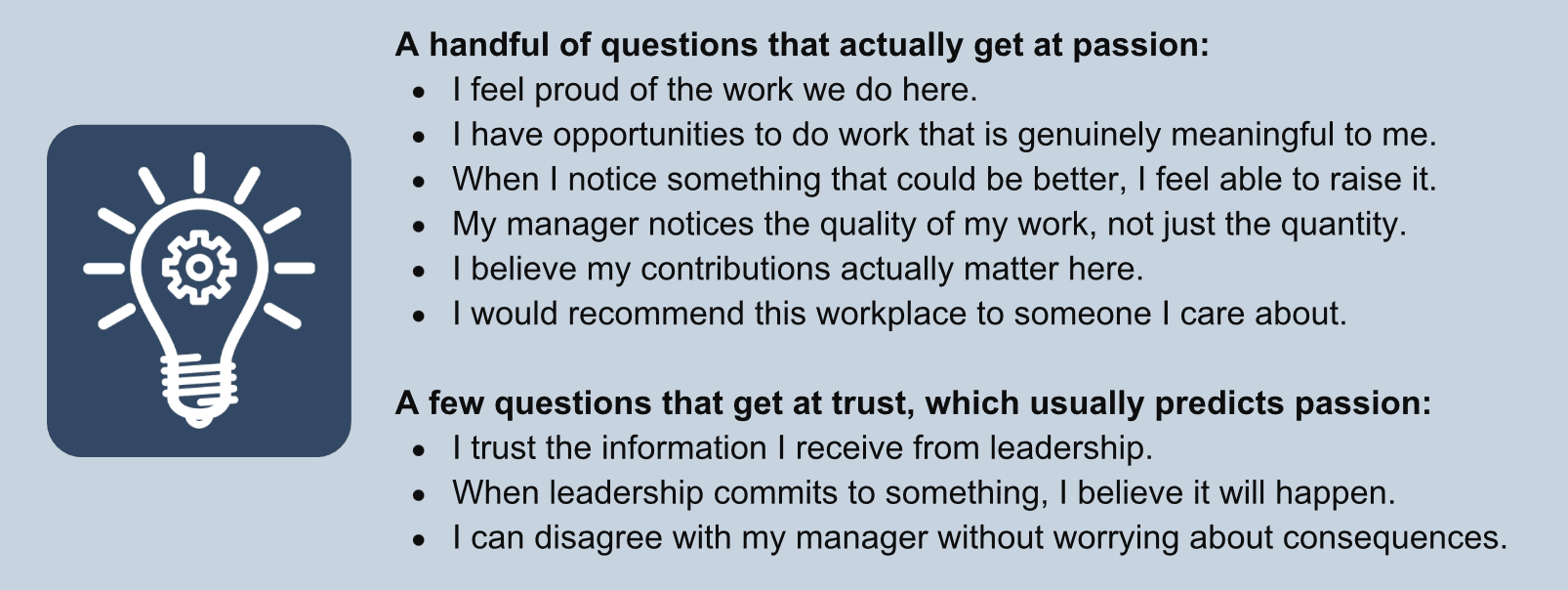
Those two alone will tell you more about the culture than most 40-question surveys, because the answers cannot be faked. Either someone can name something specific, or they cannot.
Two actions to start right now
Ask two questions in your next one-on-one. When did you last feel genuinely proud of something you did here? What is the one thing that would make you stay? Then listen. Do not defend. Do not solve. Just listen. You will learn more in ten minutes than you will from a quarterly pulse survey.
Name one quiet contribution out loud this week. Pick someone on your team who is holding something together without being asked to. Tell them specifically what you see. That is how trust compounds.
The work we do at JMC
We build engagement surveys and culture assessments that go past satisfaction metrics. The goal is to tell you whether your people are engaged, yes, but also whether they trust you, and whether they are actually invested. Three different things, and most organizations are only measuring one. If you are not sure what your team is carrying, or what they would name if someone asked, that is worth knowing.
A final thought
Passion is the part of performance most organizations refuse to manage. Not because it does not matter. Because it feels too soft to handle. It is not soft. It is the whole game. Leaders can build the conditions for it, or leave it to chance.
Most are still leaving it to chance.

JMC HR Consulting is a Moncton-based firm supporting organizations across Atlantic Canada and beyond with practical, strategic HR solutions. Our work focuses on helping organizations build strong, effective teams through executive recruitment, compensation alignment, workforce planning, organizational structure, leadership support, and employee and team assessments.
We work closely with municipalities, co-operatives, Indigenous organizations, non-profits, and private sector employers to navigate complex workforce challenges and support long-term organizational success.
Learn more about our work at www.teamjmc.ca.
https://shorturl.fm/o5yI9